


A customer recently brought me an acacia bonsai tree which had sustained some damage and had also been somewhat neglected. I was asked to restyle the tree and also to repot it. I am not a massive fan of the species but I saw it as a nice challenge and at the same time a bit of a change from my more favored pines and Chinese maples.

Image caption. The tree as it was given to me to work on.
Once you have found the "front" which best suits the tree, you might need to prop up the pot and tree with wooden blocks in order to change the planting angle; such as was needed in this case. The extreme leaning angle of the trunk did not make much sense to me as the iconic image I have of an acacia tree in my mind is one of a vertical tree standing erect and alone in the African savannah. This is not to say that you cannot have an acacia bonsai in any other style than an upright one, but I think it is just easier to capture the imagination of the viewer if you don't expect too much in the way of imagination from them.
The wild growth, the result of neglect would need to be reduced and of course the branches would need wiring and shaping. I started by removing all the dead growth and the growth which was clearly problematic, such as 3 branches growing from the same point and other such faults.

Image caption. The tree after working on it.
One always begins wiring and styling from the bottom branch. This tree was no exception. I had to use some wire stays also to change the angles of some of the more mature branches; this is a far less aggressive technique than using very thick wire which would also have damaged the bark. A branch jack makes it possible to gently and in a controlled manner open or close branch angles, once in the angle which is pleasing to you it can be frozen like that by wire.
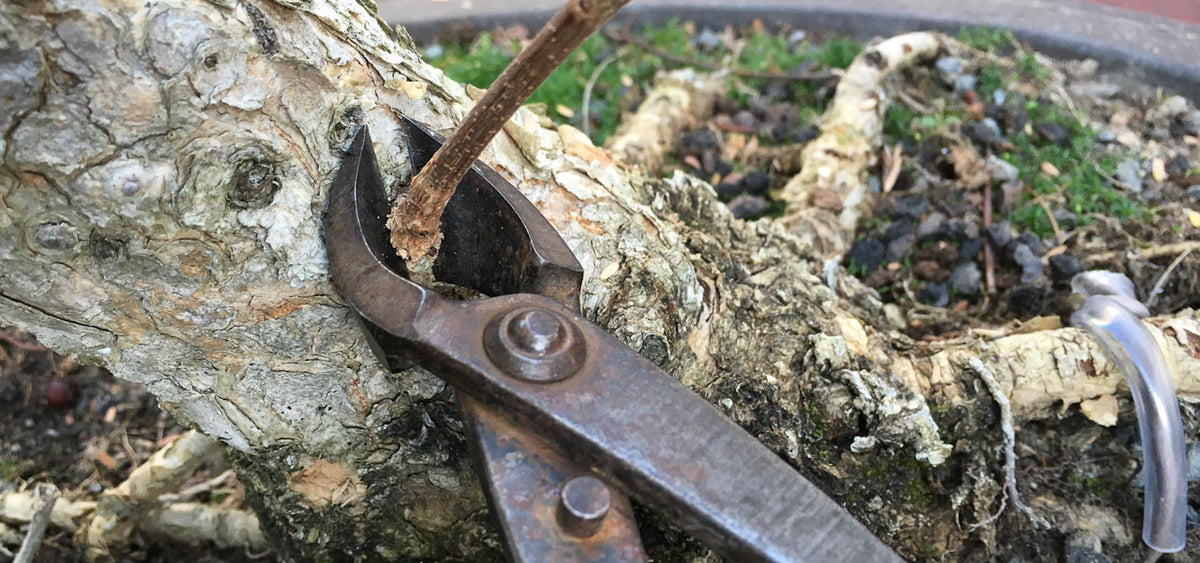
Concave branch cutters come in very handy in eliminating unwanted branches cleanly, leaving a slight concave surface which, together with suitable sealer will heal over quickly and invisibly. I only used aluminium wire on this Acacia, aside from the stays which were done with copper as its considerably stronger in thinner gauges.
You will notice that there is yet movement in the tree, from right to left. I like trees with movement, but one must be cautious not to maintain balance or the tree appears to fall but creates a sense of uneasiness in the viewer. The visual mass of foliage, or branches at the moment, balances out the movement and the tree feels stable in the container.
I used several 4mm wires to securely anchor the tree into the pot, after I repotted it at the new angle. I used the Professional mix to replace the fine, sandy mix which it was growing in. This should produce good root development and ramification, which will be echoed in the canopy above ground also.
After treatment like this, it is best not to fertilize the tree until it shows clear signs of recovery.
It would also be wise to keep it out of wind if possible as instability in the pot could damage the young and tender new roots when they emerge. Morning sun or all day dappled shade would be good for the tree also.
The customer was happy and so as a result, I was happy.


12 Comments
Great improvement to the tree. Thanks for sharing.
Hi Terry.
Another great article. Thanks so much.
I love my acacia’s and actually have quite a few. Whilst they can be quite not the nicest trees to work with (especially the ones with thorns) they are very rewarding trees if taken care of correctly.
The change you made on this tree is definitely a massive improvement and I hope the client can take it to the next level.